Operating System
OS:
- Operting System is a software that takes the control of our machine after it get turned on.
- some basic tests happen
- some power on self tests happen
- then control is given to the operating system
- and Operating System becomes incharge of the system
- Operating System provides us basic services and we call them system calls for saving data to harddisk ,mouse events ,keyboard events
- Contractor
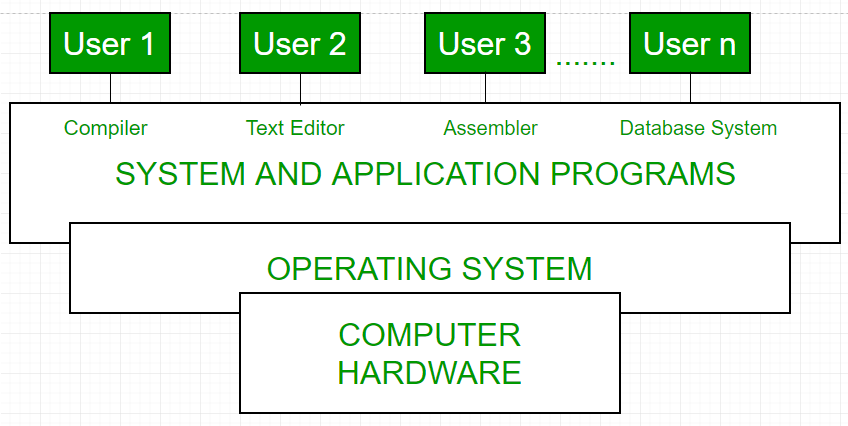
- Provide an interface to the user to communicate with hardware of the system
graph LR;
A[User]
B[Applications<br>Chrome<br>Word Pocessor]
C[Operating System<br>Mac<br>Linux<br>Windows]
D[Hardware<br>CPU<br>Memory<br>HardDisk]
Systems without OS
- In the absence of an OS, our PC will boot using a small piece of firmware known as the BIOS (Basic Input/Output System). The BIOS governs very simple features such as resetting the clock, voltage regulation or diagnosing system errors.
- Our System is made for doing one task at a time but how can we overcome that
- like we want to do multi tasking like using 10 aplications once a time so Operating system came here
- Even In the presence of os, our system do only one process at a time but OS is very smart it does very very very fast swiching between the processes
- So by the OS it is possible to do multiple task a time
Services
- Abstraction
- Our OS extracts the hardware and provides the system calls without writting any assembly or binary code by the user
- Resource Management
- OS manages the resources of the system like CPU, Memory, Harddisk, etc
- Process Management
- OS manages the processes of the system
- It decides which process will run first and which will run later
- It also decides which process will run for how much time
- Protection and Security
- OS provides the security to the system
- It provides the security to the processes
- It provides the security to the data
graph TD;
subgraph Based on Functionalities
end
A[OS]-->B[Single Tasking]
A-->C[Multi Tasking / Multi Programming]
A-->D[Multi Threading]
A-->E[Multi Processing]
graph TD;
subgraph Based on Functionalities
end
A[OS]-->B[Single Tasking<br>Only one task at a time in CPU<br> ex: MS-DOC<br>Only One Process other than CPU <br> can exist a time<br>Very Inefficient Systems]
A-->C[Multi Tasking / Multi Programming]
A-->D[Multi Threading]
A-->E[Multi Processing]
Single Tasking
graph LR;
A[Single Tasking]-->B[CPU]
C[Computation]
D[I/O]
E[Computation]
subgraph Functioning
F[Computation]-->G[I/O]
G-->H[Computation]
X[First Computation then I/O<br> during I/O CPU will wait for <br>I/O completion after I/O Completion<br>Another Computation will start by CPU<br> So this is the disadvantage<br>Our Costly CPU is Waiting for I/O]
end
Batch Processing
graph LR;
A[User 1]-->B[Job 1]
C[User 2]-->D[Job 2]
E[User 3]-->F[Job 3]
G[User 4]-->H[Job 4]
I[User 5]-->J[Job 5]
K[User 6]-->L[Job 6]
M[User 7]-->N[Job 7]
O[User 8]-->P[Job 8]
Q(OPERATOR)
B-->Q
D-->Q
F-->Q
H-->Q
J-->Q
L-->Q
N-->Q
P-->Q
Q-->R[BATCH 1<br/>Job 1,Job 2,Job 3,Job 4]
R-->S[BATCH 2<br/>Job 5,Job 6,Job 7,Job 8]
S-->T[CPU<br/>I/0]
- Jobs are submitted to the operator
- Operator will create the batches of the jobs in priority order and submit them to the CPU
- CPU will execute the jobs in the batch
Multi Programming
graph LR;
A[Multi Programming]-->B[CPU]
C[Computation]
D[I/O]
E[Computation]
subgraph Functioning
F[Computation]-->G[I/O]
G-->H[Computation]
X[During  Computation I/O <br>will be unassigned from CPU<br>and Another Computation sent to CPU so<br> here processes are running concurrently.<br>Also multiple processes in memory is there]
end
- Single CPU
- Multiple Processes in Memory
- Context Switching
- CPU Idle Time Reduced
Multi Tasking
graph LR;
A[Multi Tasking]-->B[CPU]
C[Computation]
D[I/O]
E[Computation]
subgraph Functioning
F[Computation]-->G[I/O]
G-->H[Computation]
X[During  Computation I/O <br>will be unassigned from CPU<br>and Another Computation sent to CPU so<br> here processes are running concurrently.<br>Also multiple processes in memory is there]
end
AA[Here only we run the<br>Processes in time slot manner<br> More Responsiveness]
- Single CPU
- Context Switching and Time Sharing
- Multi Tasking is also known as Time Sharing
- Multi Tasking is more responsive because we run the processes in time slot manner. We assign time t1 to c1 and t1 to c2 and so on
- Here only we run the Processes in time slot manner More Responsiveness
- CPU Idle Time Reduced further
Multi Threading
- Multiple processes in a OS
- Multiple threads in a process
- Running multiple threads in a process is known as Multi Threading
- Multi Threading is more responsive than Multi Tasking
- Multi Threading is more efficient than Multi Tasking
- Multi Threading is more efficient than Multi Tasking because in Multi Tasking we have to switch between the processes and in Multi Threading we have to switch between the threads
- Switching between the threads is more efficient than switching between the processes
- Example: Chrome Browser is a process and each tab in chrome browser is a thread so we can say that chrome browser is a multi threaded process
- Almost all the modern OS are multi threaded
- Thread : a smallest unit of execution
graph BT;
A[Program]-->B[Process]
A-->C[Process]
A-->D[Process]
A-->E[Process]
A-->F[Process]
A-->G[Process]
A-->H[Process]
B-->BA[Thread]
B-->BB[Thread]
B-->BC[Thread]
B-->BD[Thread]
B-->BE[Thread]
B-->BF[Thread]
B-->BG[Thread]
B-->BH[Thread]
C-->CA[Thread]
C-->CB[Thread]
C-->CC[Thread]
C-->CD[Thread]
C-->CE[Thread]
C-->CF[Thread]
C-->CG[Thread]
C-->CH[Thread]
D-->DA[Thread]
D-->DB[Thread]
D-->DC[Thread]
graph TB;
A[Program]-->B[Process]
A-->C[Process]
A-->D[Process]
A-->E[Process]
A-->F[Process]
A-->G[Process]
A-->H[Process]
graph TB;
A[Process]-->B[Thread]
A-->C[Thread]
A-->D[Thread]
A-->E[Thread]
A-->F[Thread]
A-->G[Thread]
A-->H[Thread]
- Multiple threads running concurrently
- Switching from one thread to another thread is less costly than switching from one process to another process
POSIX Threads
- standard library for working with POSIX threads
graph TD;
A[Thread T1]
B[Fork Point]
A-->B
B--Instruction 1<br> Print T1----->C['']
B--Thread T2 Created-->E[Instruction 2<br> Print T2]
E-->D[Thread T2]
subgraph Execution Details
X[Here it is<br> undeterminable which will <br>executed first, in 99% T1 1st. <br>Even this situation is so called<br> Thread Race Condition]
end
// This is a simple program to demonstrate how to create a thread

#include <stdio.h>
#include <stdlib.h>
#include <pthread.h> /* For working with POSIX threads*/
#include <unistd.h>  /* For pause() and sleep() */
#include <errno.h>	 /* For using Global variable errno */

/* A thread callback fn must have following prototypes
 * void *(*thread_fn)(void *)
 * */
static void *
thread_fn_callback(void *arg) {

	char *input = (char *)arg;

	while(1) {
		printf("input string = %s\n", input);
		sleep(1);
	}
}

void
thread1_create() {

	/* opaque object, dont bother about its internal
	 * members */
	pthread_t pthread1;

	/* Take some argument to be passed to the thread fn,
 	 * Look after that you always paas the persistent memory
 	 * as an argument to the thread, do not pass caller's
 	 * local variables Or stack Memory*/
	static char *thread_input1 = "I am thread no 1";

	/* Return 0 on success, otherwise returns errorcode, all
 	 * pthread functions return -ve error code on failure, they
 	 * do not set global 'errno' variable */
	int rc = pthread_create(&pthread1,
				   NULL,
				   thread_fn_callback,
				   (void *)thread_input1);
	if(rc != 0) {

		printf("Error occurred, thread could not be created, errno = %d\n", rc);
		exit(0);
	}
}

int
main(int argc, char **argv){

	thread1_create();
	printf("main fn paused\n");
	pause(); // pause() is a system call, it will not return until a signal is received
    //thread will create child threads and and wait for them to complete
	return 0;
}
main fn paused
input string = I am thread no 1
input string = I am thread no 1
input string = I am thread no 1
input string = I am thread no 1
input string = I am thread no 1
and so on .....
Multi Processing
- having our system with multiple processors
- Divide processes among the processors
- Divide threads among the processors
Multi User
- Multiple users can use the system at a time
- Example: Server,Cloud
Multi Threading vs Multi Tasking
- Multi Tasking
- Listening to music and Browsering the Web
- Multi Threading
-
Downloading a file in browser and Browsering the Web in the same browser
-
Real World Example
- Word Processsor
- Typing
- Spell Check
- Printing
- Saving
- Formatting at the same time
- Chrome Browser
- Downloading a file
- Browsering the Web
- Playing a Video
- Playing a Game at the same time
- Modern IDEs
- Compiling
- Debugging
- Typing
- Formatting
- Saving
- Spell Check
- Running at the same time
- Word Processsor
-
Advantages
- Parallelism
- Multiple threads running concurrently
- Responsiveness
- Better Resource Utilization
- Improved Performance
- Parallelism
-
Disadvantages
- Difficulty in writting , testing and debugging
- Race Condition
- Example of Race Condition| Thread 1 | Thread 2 | | --------------------------- | --------------------------- | | int a = 10; | | | a++; | | | write a back to the memory; | | | | read a; | | | a++; | | | write a back to the memory; | | a=12 finally | |
- Another Sequence of Execution| Thread 1 | Thread 2 | | --------------------------- | --------------------------- | | read a; | | | a++; | | | | read a; | | write a back to the memory; | | | | a++; | | | write a back to the memory; | | a=11 finally | |
- Can lead to deadlocks
graph LR;
T1-->R2
R2-->T2
T2-->R1
R1-->T1
subgraph DeadLocks
A[R1,R2 is unsharable<br> so only one use them at a time<br> so if T1 is using R1 and T2 is using R2<br> and T1 wants R2 and T2 wants R1<br> then DeadLocks will occur]
end
-
Threads
- If Our Process is Multi threaded then multiple stacks will be there
- Multiple Functions might be running Concurrently or Parallelly
- Concurrent Execution :
- Multiple Functions running at the same time
- Scheduler will decide which function will run first and which will run later
- One will be doing I/O and other will be doing Computation
- Parallel Execution :
- Multiple Functions running at the same time on multiple processors
			graph BT;
			subgraph Thread 1
            A[Stack1
--

--
Heap1
Data1
Code1]
            end
			subgraph Thread 2
            B[Stack2
--

--
Heap1
Data1
Code1]
            end
			subgraph Thread 3
            C[Stack3
--

--
Heap1
Data1
Code1]
            end
			subgraph All  are sharing Heap Data and Code
            end
Advantages of Threads
- Faster to create/Terminate the threads than processes
- Faster to switch between the threads than processes
- Multiple threads in a process
- Threads share the same address space
- Easy to communicate between the threads
- context switching is easier
- Easy to share the data between the threads
- Lightweight
- Threads are lightweight than processes
- Thread creation means only stack creation
Types of Threads
graph TB;
A[Threads]
B[User Managed Threads]
C[Kernel Managed Threads]
A-->B
A-->C
User Managed Threads vs Kernel Managed Threads
| User Managed Threads | Kernel Managed Threads |
|---|---|
| Manageement in User Space | Management in Kernel Space |
| Context Switching is faster | Context Switching is slower |
| Blocking: One thread might block the other threads | Blocking: A thread blocks it self Only |
| MultiCore or MultiProcessor : Can not take advantage of MultiCore or MultiProcessor Only Concurrent execution on single processor | MultiCore or MultiProcessor : Take full advantage of Multi core System |
| Creation/Termination :Fast | Creation/Termination :Slow |
| Context Switching :Fast | Context Switching :Slow |
Mapping of User Managed Threads to Kernel Managed Threads
graph TB;
subgraph One to One
subgraph User Space
subgraph Word Processor
A[ut1]
B[ut2]
C[ut3]
end
end
subgraph Kernel Space
AA[kt1]
BB[kt2]
CC[kt3]
A-->AA
B-->BB
C-->CC
end
end
subgraph Many to One
subgraph User Space
subgraph Word Processor
AX[ut1]
BX[ut2]
CX[ut3]
end
subgraph Music Player
AXX[ut1]
BXX[ut2]
CXX[ut3]
end
end
subgraph Kernel Space
AAA[kt1]
BBB[kt2]
AX-->AAA
BX-->AAA
CX-->AAA
AXX-->BBB
BXX-->BBB
CXX-->BBB
end
end
subgraph Many To Many
subgraph User Space
subgraph Word Processor
AXXXX[ut1]
BXXXX[ut2]
CXXXX[ut3]
end
subgraph Music Player
AXXXXX[ut1]
BXXXXX[ut2]
CXXXXX[ut3]
end
subgraph Kernel Space
AY[kt1]
BY[kt2]
CY[kt3]
AXXXX-->AY
AXXXX-->BY
AXXXX-->CY
AXXXXX-->AY
AXXXXX-->BY
AXXXXX-->CY
end
end
end